Directory Backlinks: Are They Still Worth It?
Published on October 14, 2026 | 7 Min Read
Key takeaways
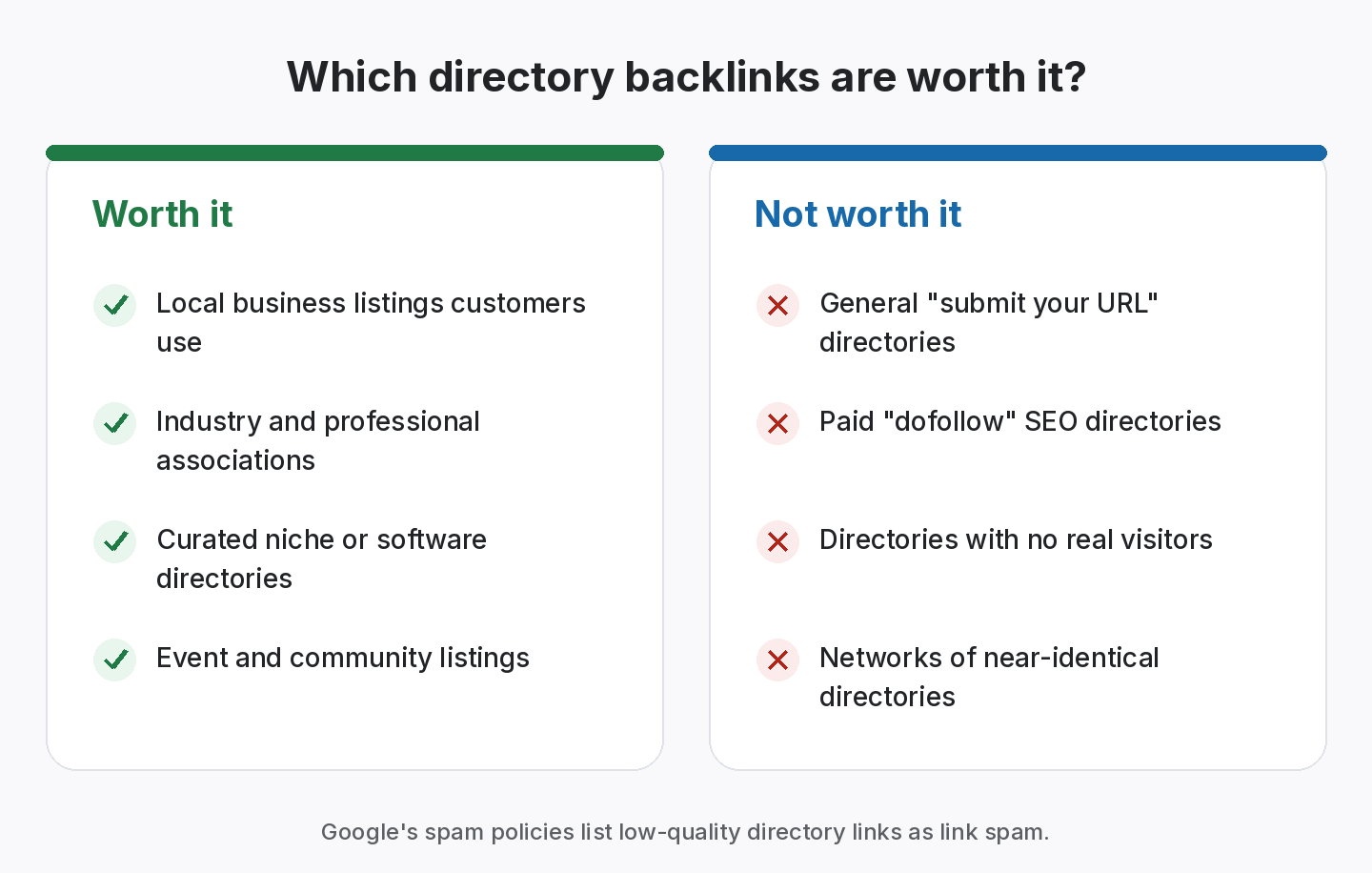
- Directory backlinks still have a place, but only from directories real people use: local, industry and association listings.
- General “submit your URL” directories built for SEO add little value and can look like a link scheme.
- Many good directory links are nofollow; their value is visibility, referrals and consistent business details.
- Keep your name, address and phone details identical across listings.
- Track every listing with its URL, login, renewal date and status so paid listings don’t lapse unnoticed.
Directory backlinks are links to your site from online directories: lists of businesses, tools, professionals or resources organised by category or location. Some are genuinely useful, such as a local chamber of commerce, an industry association or a well-run software directory that buyers browse. Others exist only to sell links, with thousands of unrelated sites listed under thin categories. Directory backlinks are still worth it when the directory itself is worth being in, for its visitors rather than its links. This guide explains how to tell the two apart, which kinds of directory to prioritise and how to keep your listings accurate.
Directory backlinks at a glance
| Directory type | Example | Worth it? | Main value |
|---|---|---|---|
| Local business listings | Map listings, city guides, chambers of commerce | Usually yes | Local visibility, consistent business details |
| Industry associations | Professional bodies, trade groups | Usually yes | Credibility, relevant referrals |
| Niche and software directories | Curated tool or supplier lists | Often yes, if buyers use them | Referrals, comparison visibility |
| Event and community listings | Meetups, conference sponsor pages | Sometimes | Audience reach |
| General web directories | “Submit your site” lists for any topic | Rarely | Little; can look like a link scheme |
| Paid “SEO directories” | Pay-per-link listing sites | No | Treated as paid links |
Directory backlinks work best from directories your customers already browse, but fall short as a shortcut to rankings through mass submissions.
What are directory backlinks?
A directory backlink is a link from a listing page in an online directory to your website. Directories group entries by category, location or industry and usually show a short profile: name, description, contact details and a link.
In the early days of search, general web directories were one of the main ways people found websites, and submitting to them was standard SEO. As search engines improved, most general directories lost their audience, and many turned into link farms. Today the useful directories are the ones with a clear purpose and real visitors.
Are directory backlinks still worth it?
Yes, selectively. The question to ask isn’t “will this link help my rankings?” but “would a potential customer find me here?” If the answer is yes, the listing is worth having whether the link is followed or not.
Where directory backlinks help
- Local businesses: consistent listings across local directories help customers find you and confirm your business details.
- B2B and software: curated directories and marketplaces are used by buyers comparing options.
- Professional services: association member directories add credibility and referrals.
- New sites: a few relevant listings help search engines and people discover you.
Where they don’t
- general directories that accept any site in any category;
- directories with no visible traffic, editorial standards or contact details;
- networks of near-identical directory sites;
- directories that sell “dofollow” links as their main product.
Google’s spam policies list “low-quality directory or bookmark site links” among examples of link spam. That is the category to avoid.
Track every listing and its renewal date
Log each directory listing with its URL and status, then check it is still live.
How to judge a directory in five minutes
Before you submit, check:
- Is it about your industry or area? A plumbing directory for plumbers; a SaaS directory for software.
- Would people use it? Look for signs of real visitors: reviews, recent listings, search features, a community.
- Does it have editorial standards? Directories that review submissions are more valuable than ones that accept everything.
- What do other listings look like? If the category is full of unrelated or spammy sites, skip it.
- What does it cost, and what do you get? A paid listing can be fine for visibility; a paid “dofollow link” is a paid link.
Nofollow directory links are normal
Many reputable directories add nofollow or sponsored to outbound links, especially for paid listings. That is fine. Google asks for paid links to be qualified with rel=”sponsored” or nofollow, and directories that follow that rule are behaving correctly. The value of these listings is visibility, referral visits and accurate business information, not ranking credit. See our nofollow vs dofollow guide for more.
Keep your business details consistent
For local businesses, the details in each listing matter as much as the link. Keep these identical everywhere:
- business name, exactly as you use it;
- address, in the same format;
- phone number;
- website URL, including whether you use www;
- opening hours and categories.
Inconsistent details confuse customers and make it harder for search engines to connect listings to your business. When you move or change phone numbers, update every listing, which is much easier if you keep a list of them.
How to build directory backlinks step by step
- List the directories your customers use. Ask customers how they found you; check where competitors are listed.
- Qualify each one with the five-minute check above.
- Prepare a standard profile: name, address, phone, description in a few lengths, logo, categories.
- Submit carefully, adjusting the description to each directory rather than pasting the same text everywhere.
- Record each listing: directory, listing URL, login, cost, renewal date and link type.
- Check listings periodically, and before each renewal.
- Update everything when your details change.
Paid directory listings
Some good directories charge for listings or for enhanced profiles. That can be a sensible marketing spend if the directory sends customers. Two things to keep in mind:
- the link from a paid listing is a paid link, so it should be sponsored or nofollow under Google’s guidance;
- paid listings lapse. If you don’t track renewal dates, the listing (and link) can quietly disappear.
Common directory link building mistakes
- Mass submissions to hundreds of general directories.
- Keyword-stuffed business names or descriptions.
- Exact-match anchor text where the directory allows it. Your business name is the natural anchor.
- Forgetting logins, which makes updates impossible later.
- Ignoring renewals on paid listings.
- Not checking listings, so outdated details stay live for years.
Worked example: a local service business
Picture a small accounting firm in one city. Its owner wants to know which directory backlinks are worth the time. An illustrative approach:
- Ask customers. Several say they found the firm through a map search or a professional body’s “find an accountant” page.
- Prioritise those. The firm completes its business profile and its professional association listing first, with identical name, address and phone details.
- Add local listings. The local chamber of commerce and a city business guide that people actually browse.
- Add one niche directory. A curated list of accountants who work with small online businesses, which matches the firm’s specialism.
- Skip the rest. Dozens of general “submit your URL” directories offered by an SEO vendor are declined.
The result is a short list of listings, most of them nofollow, that customers actually use. Each is recorded with its URL, login and renewal date, and checked twice a year.
Directory backlinks vs citations
In local SEO, a “citation” is any mention of your business name, address and phone number, with or without a link. Directory listings are a common source of citations. The link may or may not pass ranking credit; the consistent business details are useful either way. When you review listings, check both: is the link present, and are the details still correct?
How to choose which directories to prioritise
- Customers use it: first priority.
- Industry or local relevance: second.
- Editorial review: a sign of quality.
- Reasonable cost for the visibility: for paid listings.
- You can maintain it: if you can’t keep it accurate, don’t list.
A short list of well-chosen, accurate listings beats a long list of forgotten ones. If you’re cleaning up old listings, our backlink audit guide shows how to review them alongside your other links.
From the SEOENV team
When we reviewed listings for older sites, the most common issue wasn’t spammy directories; it was outdated details and expired paid listings nobody remembered buying. A simple list with renewal dates prevents both.
How SEOENV helps with directory listings
SEOENV’s Listing Backlinks module records each directory listing with its listing URL, directory, cost and notes, and the link is checked like any other in the Link Tracker, with a status (Active, Pending, Lost or Broken) and a type (Dofollow, Nofollow or Unknown). Listings are included on every plan, including Free for up to 20 links; Starter ($29 a month) adds daily automatic checks. See pricing for limits.
SEOENV doesn’t submit to directories for you. It keeps your listings on record.
Sources
- Google Search Central: Spam policies for Google web search, link spam
- Google Search Central: Qualify your outbound links to Google
- Google Business Profile Help: Guidelines for representing your business on Google
How we wrote this guide
This guide is written by the SEOENV team from how link builders actually record exchanges, paid placements and guest posts. SEOENV makes a backlink manager, so we say where a spreadsheet or another tool is enough. We do not quote statistics we cannot source.
Frequently asked questions
Keep every link you build on record
Log exchanges, ABC swaps, paid links and guest posts in one place. The Free plan covers every link type for up to 20 links.


[…] Directory listing […]