The Guest Posting Process: From Pitch to Published Link
Published on October 14, 2026 | 7 Min Read
Key takeaways
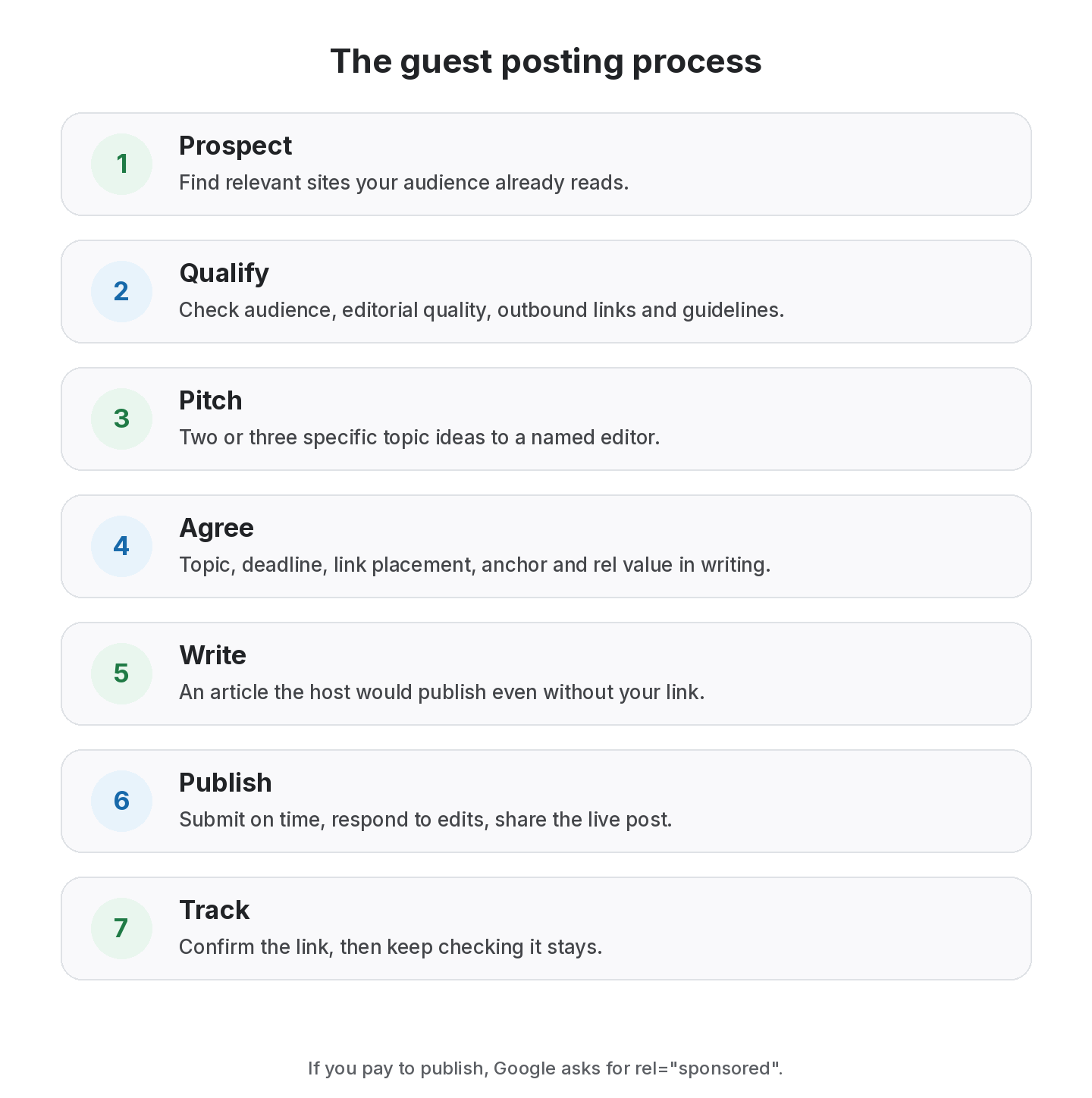
- A good guest posting process has seven stages: prospect, qualify, pitch, agree, write, publish and track.
- Pick sites for their readers, not only their metrics; a guest post should be worth reading without the link.
- Agree topic, deadlines, link placement, anchor and rel value before you write.
- If you pay to publish, the link is a paid link and Google asks for rel=”sponsored”.
- Track every post from pitch to live link, then keep checking that the link stays.
The guest posting process is the set of steps that takes a guest article from first idea to a published page with a working link back to your site. Done well, it produces useful content for another site’s readers, a relevant link and a relationship with an editor. Done carelessly, it produces thin articles, missed deadlines and links nobody checks. This guide lays out a seven-stage guest posting process, what to agree at each stage, where Google’s rules apply, and how to keep track of every post in the pipeline.
The guest posting process at a glance
| Stage | Goal | Output | Typical owner |
|---|---|---|---|
| 1. Prospect | Find relevant sites that accept contributors | Target list | Researcher |
| 2. Qualify | Check audience, quality and guidelines | Shortlist | Researcher / lead |
| 3. Pitch | Propose specific topics to an editor | Sent pitches | Outreach |
| 4. Agree | Confirm topic, deadline, link and rel value | Written brief | Outreach |
| 5. Write | Produce the article to the site’s standard | Draft | Writer |
| 6. Publish | Editor reviews and publishes | Live URL | Editor (theirs) |
| 7. Track | Confirm the link and keep checking it | Status over time | You |
A staged guest posting process works best when every post moves through the same steps, but falls short when the pipeline lives in inboxes and nobody owns the follow-up.
Stage 1: prospect for relevant sites
Start with sites your audience already reads. Useful sources:
- publications and blogs you cite in your own content;
- sites that rank for topics close to yours;
- industry associations, newsletters and community blogs;
- “write for us” or contributor pages in your niche;
- sites where competitors or peers have published useful articles.
Collect the site, the relevant section, the editor’s name if you can find it, and any contributor guidelines.
Stage 2: qualify each site
Not every site that accepts guest posts is worth writing for. Check:
- Audience fit: do they write for people who could use your product or expertise?
- Editorial quality: are existing posts useful, edited and original?
- Outbound links: do posts link out naturally, or are they stuffed with commercial links?
- Guidelines: word count, style, link policy and whether they charge a fee.
- Activity: are they publishing regularly, and are posts indexed?
Sites that charge for every guest post and publish anything are selling links. If you pay, the link is paid and Google asks for rel=”sponsored”. Our guide to paid backlinks and Google’s rules explains why.
Stage 3: pitch specific topics
Editors respond to pitches that show you know their site. Send two or three specific topic ideas, each with a working title, a one-line angle and why it fits their readers. Mention relevant experience briefly. Keep it short. We share a full template in our guest post outreach email guide.
Follow up once or twice, politely, then move on. Record each pitch and its date so nobody pitches the same editor twice by accident.
Stage 4: agree the details in writing
Before anyone writes, confirm:
- the topic and outline;
- word count and deadline;
- how many links you can include, where, and to which pages;
- anchor text, ideally natural and descriptive;
- whether links are normal links, nofollow or sponsored;
- whether a fee is involved, and if so its amount and terms;
- who owns the content, and whether you can republish excerpts.
A short email confirming these points is enough. It becomes your reference if something changes after publication.
Track every guest post from pitch to live link
Move each post through Pitched, Writing, Submitted and Live, then check the link.
Stage 5: write something worth publishing
A guest post should be good enough that the host would publish it without your link. That means:
- writing for their readers, in their style;
- bringing real experience, examples or data you can stand behind;
- linking to your site only where it genuinely helps the reader;
- citing other good sources, not only your own pages;
- following the site’s formatting and image guidelines.
Google’s guidance on helpful, people-first content is a good bar for guest content too.
Stage 6: submit and publish
Send the draft in the format the editor asked for, on time. Respond quickly to edits. Once it’s live, thank the editor and share the post with your own audience. That helps the host and makes the next pitch easier.
Stage 7: track the link
When the post goes live, confirm:
- the link is present and points at the agreed page;
- the anchor matches what was agreed;
- the rel value is what was agreed;
- the page is indexed in due course.
Then keep checking. Editors update older posts, and links in guest articles are often trimmed during refreshes. See why backlinks disappear for the usual causes.
A simple guest post pipeline
Use the same statuses for every post so anyone on the team can see where things stand:
- Prospect: on the list, not yet contacted.
- Pitched: pitch sent, waiting for a reply.
- Accepted: topic agreed, terms confirmed.
- Writing: draft in progress.
- Submitted: with the editor.
- Live: published, link confirmed.
- Declined / no reply: closed, with a date.
Each record should hold the site, editor, topic, deadlines, target page, anchor, rel value, any fee and the live URL.
Common guest posting mistakes
- Mass pitching with a template. Editors spot it immediately.
- Choosing sites by metrics alone. A high score on an irrelevant site helps nobody.
- Over-optimised anchors. Repeating the same keyword anchor across posts is a pattern to avoid.
- Paying without qualifying the link. Paid guest posts are paid links.
- Forgetting follow-ups. Many accepted pitches stall because nobody chased the deadline.
- Never checking again. A guest post link that disappears six months later is still lost value.
Worked example: one guest post through the pipeline
Here is how a single guest post might move through the process for a small B2B software company. The details are illustrative.
Prospect and qualify. The marketer keeps a list of publications its customers read. One is an operations blog that publishes a contributor article every couple of weeks, edits them carefully and links out sparingly. Its guidelines say links must be relevant and editorially justified, and it doesn’t charge fees.
Pitch. The marketer reads three recent articles and notices the blog has covered hiring and onboarding but not handovers between teams. She pitches three ideas, one of which is “How to hand over a client account without losing context”.
Agree. The editor picks that topic and asks for an outline. They agree a word count, a deadline three weeks out, and one link to the company’s handover checklist, with a descriptive anchor. The link will be a normal link because no payment is involved.
Write and publish. The article uses the marketer’s own handover experience, cites two other sources and links to the checklist once, where it genuinely helps. The editor asks for one section to be shortened; it goes live a week after submission.
Track. The marketer confirms the link, anchor and rel value, records the live URL and sets the post to Live. Five months later a recheck shows the link has been removed during an article refresh. Because the original agreement is on record, a short email gets it restored.
The whole process took several weeks of elapsed time but only a few hours of work, most of it on the article itself. That ratio is typical of guest posts that are worth doing.
Guest posting and Google’s guidelines
Google’s spam policies list “large-scale article marketing or guest posting campaigns with keyword-rich anchor text links” as an example of link spam. Two things in that sentence matter: scale and keyword-rich anchors. A handful of well-written articles on relevant sites, with natural anchors, is a different activity from publishing hundreds of near-identical posts to build links. If a fee is paid to publish, Google asks for the link to be qualified with rel=”sponsored” or nofollow.
How to choose which sites to write for
Use this checklist before you pitch:
- Would your ideal customer read this site?
- Is the content edited and original?
- Does the site publish guest posts selectively?
- Is the link policy clear and honest?
- Can you write something genuinely useful for them?
- Can you track the post and the link afterwards?
If the answer to the first two is no, the rest doesn’t matter.
From the SEOENV team
The biggest gains we’ve seen in guest posting came from fewer, better pitches. Tracking every pitch made it obvious which editors replied and which topics landed, so the next round got smaller and more targeted.
How SEOENV helps with the guest posting process
SEOENV’s Guest Posts module tracks each post from pitch to live link, with the site, editor, topic, deadlines and target page in one record. Once the post is live, the link appears in the Link Tracker with a status and type, and editor contacts sit in Partners. Read more on the guest post tracker page.
Guest posts are included on every plan, including Free for up to 20 links. Starter ($29 a month) adds automatic daily checks. SEOENV doesn’t find sites, write pitches or send outreach for you; it keeps the process organised.
Sources
- Google Search Central: Spam policies for Google web search, link spam
- Google Search Central: Qualify your outbound links to Google
- Google Search Central: Creating helpful, reliable, people-first content
How we wrote this guide
This guide is written by the SEOENV team from how link builders actually record exchanges, paid placements and guest posts. SEOENV makes a backlink manager, so we say where a spreadsheet or another tool is enough. We do not quote statistics we cannot source.
Frequently asked questions
Keep every link you build on record
Log exchanges, ABC swaps, paid links and guest posts in one place. The Free plan covers every link type for up to 20 links.


[…] Previous […]