How to Measure Link Building ROI (Without Guessing)
Published on October 14, 2026 | 7 Min Read
Key takeaways
- Link building ROI compares what your links cost with the value they bring, over the time they stay live.
- Start with cost you can prove: price, hours and tools per link, recorded on the day you agree each deal.
- Value is harder: use referral traffic, conversions and revenue where you can track them, and treat ranking gains as supporting evidence.
- Lost links reduce ROI, so link lifespan belongs in the calculation.
- Report ROI as a range with your assumptions written down, not as a single confident number.
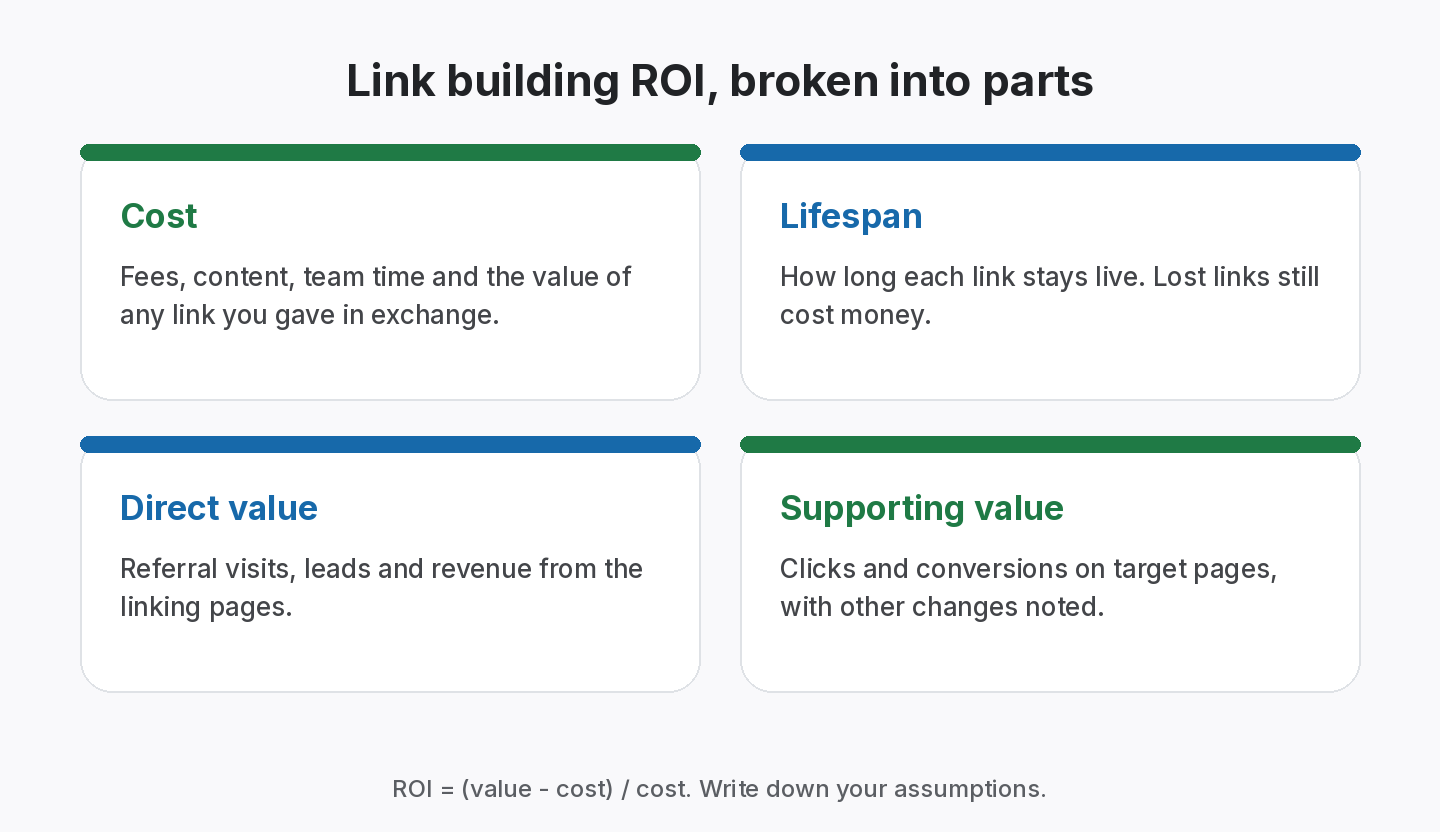
To measure link building ROI, compare the full cost of the links you built with the value they produced over the time they stayed live. The cost side is easy to prove if you record it: fees, hours and tools per link. The value side is harder, because links influence rankings slowly and indirectly. The honest approach is to track the value you can see directly (referral visits, leads and revenue from linked pages), use ranking and traffic changes as supporting evidence, and write down your assumptions. This guide shows a practical way to do that.
Link building ROI methods at a glance
| Method | What it measures | Best for | Limitation |
|---|---|---|---|
| Cost per live link | Spend divided by links still live | Comparing vendors and tactics | Says nothing about value |
| Referral value | Visits, leads or sales from the linking pages | Paid placements, PR, partner links | Misses ranking impact |
| Target page value | Organic traffic and conversions on linked pages | Pages that gained links | Many other factors move traffic |
| Blended ROI | (Value − cost) ÷ cost, with stated assumptions | Client and budget reviews | Only as good as the inputs |
Cost per live link works best for comparing tactics, but falls short as a full ROI measure; pair it with tracked value from referral and target pages.
Why link building ROI is hard to measure
Links rarely produce value on their own schedule. A link may take weeks to be crawled, its effect on rankings is mixed with content changes, competitors and algorithm updates, and some links send visitors directly while others mostly matter for search. On top of that, links are not permanent. A link that disappears after three months delivered less than one that lasted three years, even if both cost the same.
So rather than hunting for one perfect formula, build the measurement from parts you can defend.
Step 1: record the true cost of every link
Cost is the half of ROI you control completely, so make it complete.
- Direct cost: the fee paid for a placement, sponsored post or listing.
- Content cost: writing, editing and design for guest posts or assets.
- Time cost: hours spent on prospecting, outreach and follow-up, multiplied by what an hour of that work costs you.
- Exchange cost: for link swaps, the value of the link you gave in return. Many teams ignore this; it is real.
- Tool cost: a share of the software you use for link building.
Record the cost on the day the deal is agreed, against the specific link. Reconstructing costs at the end of a quarter from invoices and inboxes is where most ROI reports lose accuracy. Our guide to paid backlinks and Google’s rules covers what else to log for paid placements.
Step 2: track how long each link stays live
A link’s value accumulates over time, so its lifespan matters. Recheck links on a schedule and record when each one goes Lost or Broken. Then you can calculate:
- Cost per live link: total spend ÷ links still live today.
- Cost per link-month: spend ÷ the total number of months your links were live.
These two numbers often change how you see vendors. A cheap placement that disappears in two months can cost more per live month than an expensive one that lasts years. Our guide to why backlinks disappear covers the usual causes.
Put a cost on every link you build
Log price and type per link, then see cost per live link. ROI Calculator from Starter.
Step 3: measure the value you can see directly
Some value is directly attributable:
- Referral traffic: visits from the linking page, in your analytics referral reports.
- Referral conversions: sign-ups, leads or sales from those visits, if you track goals.
- Revenue: for e-commerce or SaaS, revenue tied to referral sessions.
Paid placements, partner links and PR coverage often show clear referral value. Many SEO-focused links show little. That is fine; it simply means you need step 4 as well.
Step 4: use target page performance as supporting evidence
For links that matter mostly for search, look at the target page:
- organic clicks and impressions in Google Search Console, before and after the link went live;
- rankings for the page’s main queries;
- conversions from organic visits to that page.
Treat this as evidence, not proof. Write down anything else that changed: content updates, internal links, seasonality or algorithm updates. When several links point at one page, attribute the change to the group, not to a single link.
Step 5: put it together
A simple, defensible formula:
ROI = (value − cost) ÷ cost
Where value combines direct referral value with an agreed estimate of organic value. For the organic part, many teams use the cost of buying the same clicks through ads, or the value of the conversions those clicks produced. Whatever you choose, state it in the report.
Worked example (illustrative numbers)
These figures are invented to show the arithmetic, not results from any real campaign.
| Item | Amount |
|---|---|
| 10 links: fees | $1,500 |
| Content and outreach time | $500 |
| Total cost | $2,000 |
| Links still live after 6 months | 8 of 10 |
| Cost per live link | $250 |
| Referral revenue from linking pages | $900 |
| Agreed estimate of organic value on target pages | $2,100 |
| Total value | $3,000 |
| ROI | ($3,000 − $2,000) ÷ $2,000 = 50% |
Notice the two lost links. They still cost money, so they lower ROI and raise cost per live link. Tracking them is what makes the number honest.
Common link building ROI mistakes
- Counting only fees. Time and exchanged links are costs too.
- Crediting every ranking gain to links. Content and technical changes often do as much.
- Ignoring lost links. A link that vanished still cost money.
- Reporting one precise number. Give a range and the assumptions behind it.
- Measuring too early. Many links take months to show an effect.
- Mixing clients. Calculate ROI per client and project, not across the whole agency.
Which costs and values to include for each link type
Different link types carry different costs and produce value in different ways. Use this table to decide what to record.
| Link type | Main costs | Most visible value |
|---|---|---|
| Paid placement | Fee, negotiation time | Referral visits and leads |
| Guest post | Writing, editing, outreach time | Target page gains, some referrals |
| Link exchange | Outreach time, the link you gave | Target page gains |
| Three-way exchange | Time, the link given from your other site | Target page gains |
| Directory listing | Listing fee if any, setup time | Local visibility, some referrals |
| Digital PR | Research, content, outreach time | Referrals, brand searches, links earned later |
Assumptions worth writing down
Every ROI report rests on assumptions. Writing them at the top saves arguments later.
- Time value: what you charge, or what an hour of team time costs.
- Organic value method: equivalent ad cost, conversion value, or a client-agreed figure.
- Attribution window: how many months after a link goes live you count value.
- Shared credit: how you split value when several links point at one page.
- Exclusions: content updates, migrations or campaigns that affected the same pages.
When a client or manager questions the number, you can point to the assumption, not defend a guess. If they would prefer a different method, you can recalculate with theirs and show both.
Reporting link building ROI to clients
Keep the ROI section short and calm. Show the cost table, cost per live link, any tracked referral value and the blended estimate with its assumptions. Then show what you will change: vendors you will stop using because their links didn’t last, tactics that earned referrals, pages that need more support. ROI is most useful as a guide to next quarter’s budget, not as a grade on the last one.
How to choose the right ROI measure
- Paid placements: cost per live link plus referral value.
- Guest posts and exchanges: cost per live link plus target page evidence.
- Agency retainers: a monthly blended view per client, with the assumptions in the report. See link building KPIs for what to show alongside it.
- Budget decisions: compare cost per link-month across vendors and tactics.
From the SEOENV team
We found the single biggest improvement to ROI reporting was recording the price on the day of the deal. Everything else can be estimated later; a missing cost can’t.
How SEOENV helps measure link building ROI
In SEOENV you can record the cost and type of every link as you log it, and see its status over time in the Link Tracker. The ROI Calculator is included from Starter ($29 a month), and Growth ($149 a month) adds ROI revenue tracking. For paid placements, the paid link tracking page shows how price, vendor and rel value are logged together.
SEOENV doesn’t connect to your analytics or claim to attribute rankings. You bring the value figures; it keeps the costs and link lifespans accurate. Compare plans on the pricing page.
Sources
- Google Search Central: Search Console Performance report
- Google Search Central: Qualify your outbound links to Google
- Google Search Central: Creating helpful, reliable, people-first content
How we wrote this guide
This guide is written by the SEOENV team from how link builders actually record exchanges, paid placements and guest posts. SEOENV makes a backlink manager, so we say where a spreadsheet or another tool is enough. We do not quote statistics we cannot source.
Frequently asked questions
Keep every link you build on record
Log exchanges, ABC swaps, paid links and guest posts in one place. The Free plan covers every link type for up to 20 links.


[…] Measurement: do you have a way to see referral visits or leads from the placement? See our guide to measuring link building ROI. […]