Three-Way Link Exchange: How ABC Link Swaps Work
Published on October 14, 2026 | 8 Min Read
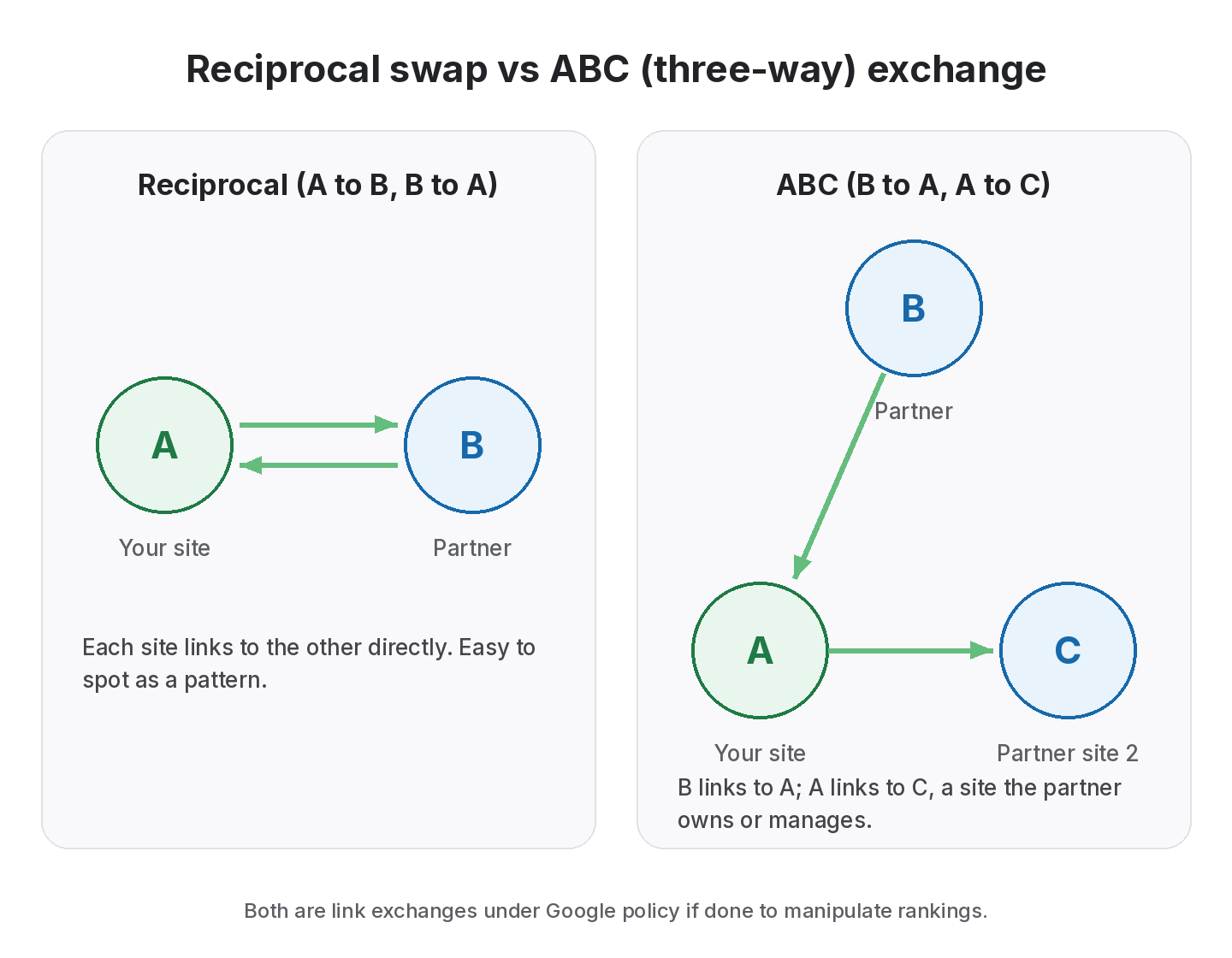
Key takeaways
- In an ABC exchange, B links to A and A links to C. Nobody links straight back.
- People use it because direct reciprocal links are easy to see as a pattern.
- Google lists excessive link exchanges as link spam. A three-way structure doesn’t change that.
- Because three sites and two links are involved, ABC deals are easy to lose track of. Record both legs and recheck them.
A three-way link exchange (often called an ABC link exchange) is a link swap across three sites. Site B links to your site (A), and in return you link to a third site (C) that the partner owns or manages, instead of linking straight back to B. It is designed so the links don’t point directly at each other. It is still a link exchange, though, so Google’s spam policies on link schemes apply in the same way as to a reciprocal swap.
Three-way vs two-way exchange at a glance
| Two-way (reciprocal) | Three-way (ABC) | |
|---|---|---|
| Links involved | 2, pointing at each other | 2, across 3 sites |
| Who you link to | The partner (B) | The partner’s other site (C) |
| How visible the pattern is | Very visible | Less direct, still detectable |
| Google policy | Link exchange if excessive | Link exchange if excessive |
| Tracking effort | One deal, two links | One deal, two links, two sites to recheck |
A three-way link exchange works best with a partner who runs several relevant sites, but falls short as a way to hide link swapping from Google.
What is a three-way link exchange?
The name comes from the three sites involved:
- Site A is your site, the one that receives a link.
- Site B is the partner’s site, which places a link to A.
- Site C is another site the partner owns, manages or works for, which receives your link in return.
So the deal is two links: B to A, and A to C. It’s also called a three-way link exchange, triangle link building or a 3-way swap. Agencies sometimes run them across clients, with one client’s site linking to another’s.
Track both legs of every three-way swap
Record the partner, both links and the sites involved in one deal.
Why people use three-way link swaps
The main reason is that direct reciprocal links are obvious. If A links to B and B links to A, anyone looking at either site can see the swap. In an ABC deal the links point in a triangle, so the connection isn’t visible from any one site.
There are also practical reasons. The partner’s most relevant page for your audience might be on site C, not B. Or the partner manages several sites and wants to spread links across them. Those reasons can be legitimate. Hiding a swap is not.
Is a three-way link exchange safe?
Google’s spam policies describe link spam as links intended to manipulate rankings, and list “excessive link exchanges” among the examples. They don’t make an exception for exchanges that go through a third site. If a three-way swap exists mainly to pass ranking credit, it’s the same thing in a different shape. The same policy also lists large-scale link schemes and networks, and many ABC arrangements across agencies start to look like one.
So treat ABC exchanges with the same caution as reciprocal ones, and probably more:
- Relevance first. Both links should make sense for the readers on each page.
- Low volume. A few chosen deals, not a standing arrangement across dozens of sites.
- No money. If anyone is paid, it’s a paid link and should carry rel=”sponsored”. See our paid backlinks guide.
- Know who owns site C. You’re linking to it from your own content, so check it as carefully as you would any other outbound link.
For the wider picture on swaps, read what a link exchange is in SEO and whether it’s safe.
How to set up a three-way link exchange carefully
- Find the right pages. Identify where on site B a link to you helps readers, and where on your site a link to site C helps yours.
- Check site C. Look at its content, topic and outbound links. If you wouldn’t link to it without a deal, don’t link to it with one.
- Agree both legs in writing. Note the B page, the A target, the A page, the C target and the anchors for each.
- Decide the order. Agree who goes first and how long each side has to place their link.
- Log both legs together. One record should hold both links, so you can see if one side drops out.
- Check both links on a schedule. Confirm B’s link to you is live and dofollow as agreed, and that your link to C is still in place.
- End deals cleanly. If the partner removes their link, decide whether to remove yours, and record the date.
Worked example: tracking a three-way swap
Sample data. The sites and dates are invented to illustrate the process.
example-saas.com (A) agrees a three-way exchange with a partner who runs two blogs: marketing-blog.example (B) and growth-tips.example (C).
| Leg | Source page | Target | Anchor | Check 1 | Check 2, 8 weeks later |
|---|---|---|---|---|---|
| B to A | marketing-blog.example/crm-guide | example-saas.com/features | example-saas.com | Active, Dofollow | Active, Dofollow |
| A to C | example-saas.com/blog/growth | growth-tips.example/onboarding | onboarding checklist | Active, Dofollow | Active, Dofollow |
| B to A (second article) | marketing-blog.example/tools | example-saas.com/pricing | pricing plans | Active, Dofollow | Lost |
At the second check, one of the two links from site B has gone. Because both legs and both articles were recorded against the same deal, the team can see the balance has changed: they’re still linking to C, but now get one link from B instead of two. They email the partner with the exact page and anchor. If the link isn’t restored, they’ve agreed in advance to review their link to C.
Without a joined-up record, this is hard to spot. The lost link and the link they gave are on different sites, so a check of either one alone would miss the imbalance.
Red flags in three-way link exchange offers
Most ABC offers arrive by cold email, and many come from link networks rather than site owners. Before you agree, watch for these signs:
- Site C is unrelated to your content. If you’d have no reason to link to it otherwise, the deal exists only for the link.
- The partner offers a long list of sites. A menu of dozens of blogs to choose from usually means a network, which Google’s policies treat as a link scheme.
- The anchor text is dictated. Being told to use an exact keyword phrase on your side is a sign the link is meant to manipulate rankings.
- Nobody can say who owns site C. You’re linking to it from your own content, so you should know who runs it.
- Money appears halfway through. If the “exchange” turns into a fee plus a link, treat it as a paid link and qualify it with rel=”sponsored”.
A good three-way exchange looks a lot like a good editorial link: two pages that would reasonably cite each other’s content, agreed between people who know each other’s sites. If an offer doesn’t look like that, it’s usually better to say no.
Three-way link exchange vs other link swap formats
It helps to compare the three-way format with the other swaps people propose.
- Two-way reciprocal exchange: simpler and more transparent. If the partnership is genuine, the directness isn’t a problem. See our reciprocal link exchange guide.
- Four-way or “ABCD” exchanges: the same idea with more sites. Every extra site adds tracking work and risk, with no change in how Google’s policy applies.
- Content swaps: each side writes an article for the other. If both articles are useful on their own, this is usually the easiest swap to defend.
- Partner page listings: good for real business relationships, poor when the page exists only to hold links.
In our experience, the three-way format is chosen mostly to make the pattern harder to see. That is the wrong reason. The right reason is that the partner’s second site is genuinely the better fit for your readers. If that’s true, the format is fine. If it isn’t, a simpler swap or no swap is better.
How to choose a three-way exchange partner
Three sites means three chances for a weak link in the chain. Check all of them.
- Site C is real: confirm the partner actually owns or manages the site you will link to, and that it is relevant to your readers.
- Site B is relevant: the page linking to you should make sense to your audience, not just exist.
- No network footprint: if B and C share templates, authors and outbound-link patterns with dozens of other sites, decline.
- Matching value: agree what “fair” means up front, for example page type, indexing and rel value, rather than metrics alone.
- Clear duration: both legs should stay live for the same agreed period.
- One record for both legs: log the deal so a lost link on either side is noticed. Your site inventory should show which of your sites took part.
If you can’t verify who owns site C, treat the offer as a red flag rather than an opportunity.
How SEOENV tracks ABC link exchanges
SEOENV has a dedicated ABC Link Exchange module for three-way deals. You record the partner, both legs, the pages and anchors in one place, and each link also appears in the Link Tracker with its status (Active, Pending, Lost or Broken) and type (Dofollow, Nofollow or Unknown). Keep partner details in Partners and the sites you can offer in Site Inventory.
ABC exchanges are included on every plan, including Free, for up to 20 links with manual checks using Check all. Starter ($29 a month) adds automatic daily checks and the Link Status Report. Read more on our ABC link exchange solution page or see the pricing page.
As with all exchanges, SEOENV is there for record keeping and quality control. It doesn’t find partners or arrange swaps for you.
From the SEOENV team
Three-way deals went wrong for us in a predictable way: one leg dropped and nobody noticed, because the two links lived on different sites and in different rows of a spreadsheet. Tying both legs to one record was the single change that fixed it.
Sources
- Google Search Central: Spam policies for Google web search, link spam
- Google Search Central: Qualify your outbound links to Google
- Google Search Central: Creating helpful, reliable, people-first content
How we wrote this guide
This guide is written by the SEOENV team from how link builders actually record exchanges, paid placements and guest posts. SEOENV makes a backlink manager, so we say where a spreadsheet or another tool is enough. We do not quote statistics we cannot source.
Frequently asked questions
Keep every link you build on record
Log exchanges, ABC swaps, paid links and guest posts in one place. The Free plan covers every link type for up to 20 links.


[…] Three-way or ABC exchange: B links to A, and in return A links to C, a third site the partner owns or manages. We cover this in our guide to ABC link exchanges. […]
[…] Previous […]
[…] you which of your sites could host that link, and the record of the exchange should name it. Our three-way link exchange guide explains the format and its […]