What Is Link Exchange in SEO? How It Works and When It Is Safe
Published on October 14, 2026 | 8 Min Read
Key takeaways
- A link exchange is any “you link to me, I link to you” arrangement, whether direct (reciprocal) or three-way (ABC).
- Google’s spam policies name “excessive link exchanges” as a link scheme. The word that matters is excessive.
- Relevance to the reader is the best test: would you add this link if no link came back?
- Keep a record of every exchange so you can recheck it, spot patterns and end deals that go wrong.
A link exchange in SEO is an agreement where two or more websites link to each other, usually so that each one gets a backlink. Done occasionally between genuinely related sites, with links that help readers, it is a normal part of how the web works. Done at scale, or mainly to move rankings, it falls under what Google calls link spam. The safe version is small, relevant and well recorded.
Link exchange types at a glance
| Type | How it works | Best for | Risk if overused |
|---|---|---|---|
| Reciprocal (two-way) | A links to B, B links to A | Genuine partners who serve the same readers | Easy to spot as a pattern |
| Three-way (ABC) | B links to A, A links to C | Partners with more than one relevant site | Harder to track; still a link exchange |
| Content swap | Each side writes a guest post for the other | Businesses with real expertise to share | Thin posts written only for links |
| Partner / resource page | Both list each other on a partners page | Real suppliers, integrations, associations | Pages built only to cross-link |
A link exchange works best between a small number of genuinely related sites, but falls short when it is used to build links at volume.
What is a link exchange?
A link exchange is a deal between site owners to place links to each other’s pages. The simplest form is a reciprocal link: site A links to site B, and site B links back to site A. People also call this link swapping, backlink exchange or reciprocal linking.
Exchanges usually start in one of three ways. A writer emails a site they already cite and asks for a mention in return. Two businesses that serve the same customers agree to recommend each other. Or an SEO agency trades placements across the sites it works with. The first two can be perfectly natural. The third is where risk tends to build up, because the links follow the agency’s client list rather than what readers need.
Common types of link exchange
- Reciprocal (two-way): A links to B and B links to A. The easiest type to set up and the easiest pattern to notice.
- Three-way or ABC exchange: B links to A, and in return A links to C, a third site the partner owns or manages. We cover this in our guide to ABC link exchanges.
- Content-for-link swaps: each side writes a guest post for the other, with a link to their own site in the article.
- Resource and partner pages: both sites list each other on a “partners” or “resources” page.
Is link exchange safe for SEO?
The honest answer is: it depends on why and how you do it. Google’s spam policies for Google web search describe link spam as links intended to manipulate rankings in Google Search results. Among the examples they list are “excessive link exchanges (‘Link to me and I’ll link to you’) or partner pages exclusively for the sake of cross-linking”.
Two details in that wording are worth reading carefully. First, the problem is exchanges that are excessive. Two related businesses linking to each other once is not what the policy is aimed at. Second, it calls out partner pages made “exclusively” for cross-linking, meaning pages that exist only to hold links, not to help anyone.
Google also says, in the same policy, that sites violating these rules may rank lower or not appear in results at all. So the cost of getting this wrong is not just a wasted link. It can affect the pages you were trying to help.
Keep every link exchange on record
Log both sides of each swap and see when a partner removes your link. The Free plan covers 20 links.
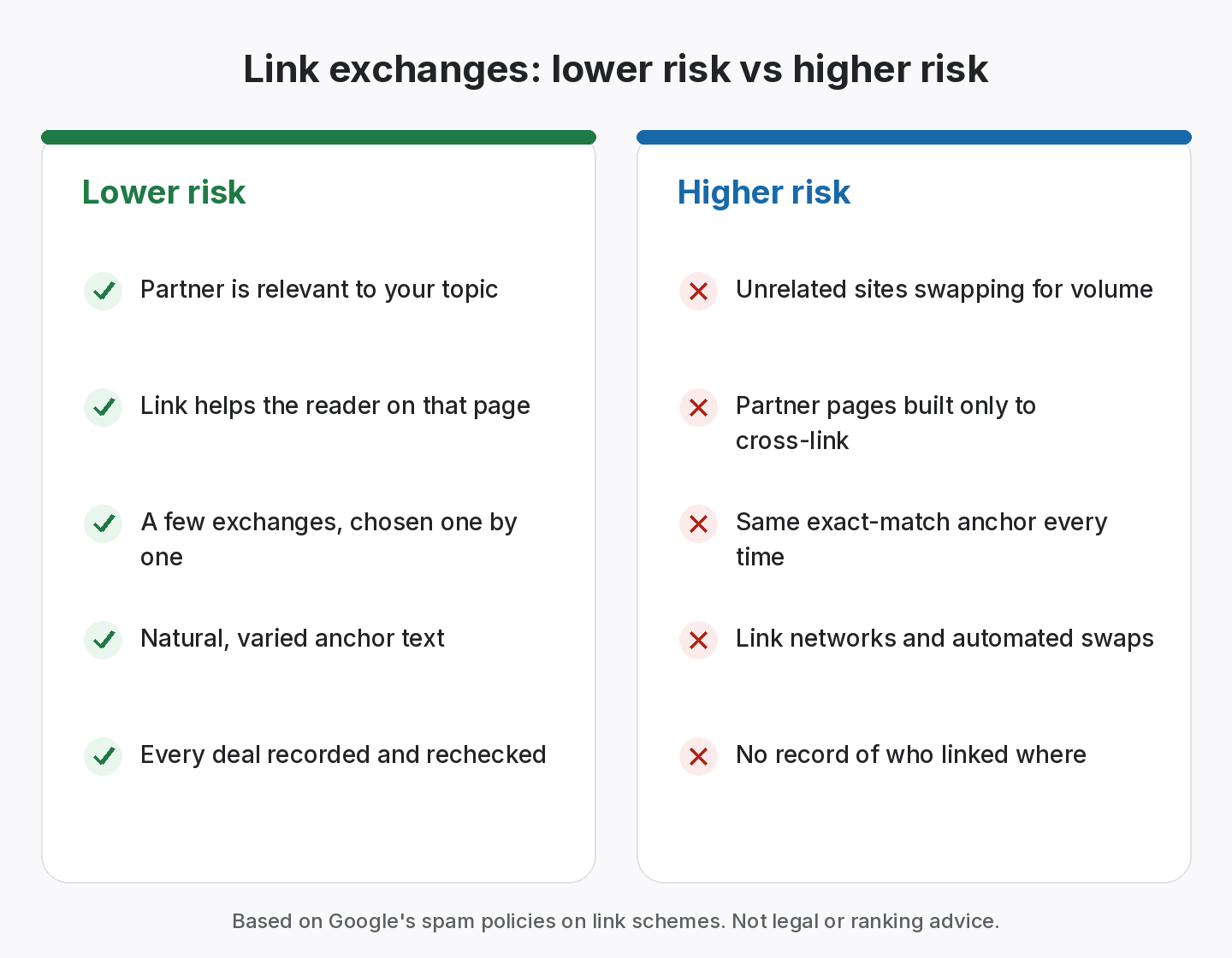
Signs an exchange is lower risk
- The partner covers a related topic, and their readers would plausibly click your link.
- The link sits inside useful content, not in a footer or a long list of unrelated sites.
- You agree each exchange one at a time, on its merits.
- Anchor text varies naturally: your brand name, the page title, a plain URL.
Signs an exchange is higher risk
- You are swapping with any site that will say yes, regardless of topic.
- Many of your new backlinks come from exchanges, and few come from links nobody asked for.
- Every link uses the same exact-match keyword as its anchor.
- The deal involves link networks, automated swap tools or pages that exist only to hold links.
How to run a link exchange the careful way
If you decide an exchange makes sense, a few habits keep it in the lower-risk column and make it easier to manage.
- Start with the reader. Before you ask, find the page on the partner’s site where your link would genuinely help. If you can’t find one, skip the deal.
- Check the partner’s site. Look at whether it publishes real content for real readers, whether it covers your topic and whether its outbound links look curated or for sale.
- Agree the details in writing. Note the page that will link to you, the page you will link to, the anchor text and roughly when each link goes live.
- Place your side honestly. Link where it helps your own readers. If any money or other compensation is involved, it stops being a simple exchange and becomes a paid link, which Google asks you to qualify with rel=”sponsored”. Our paid backlinks guide covers this.
- Record the exchange. Log both links, the partner, the date and the agreed anchor.
- Recheck both sides. Partners redesign sites, remove pages and switch links to nofollow. Check that your link is still live and that you are still keeping your side of the deal.
- Review the pattern. Every month or quarter, look at how many of your new links come from exchanges and how varied the anchors are. If exchanges are taking over, slow down.
Worked example: logging and checking an exchange
Sample data. The domains and figures below are invented to show the process.
A small project management SaaS, example-saas.com, publishes a guide to remote team rituals. A related blog, partner-blog.example, has an article on async stand-ups that would benefit from linking to that guide. The two editors agree an exchange: partner-blog.example links to the rituals guide, and example-saas.com links to the partner’s async stand-up article from its own meetings page.
| Field | Link to us | Link from us |
|---|---|---|
| Source page | partner-blog.example/async-standups | example-saas.com/blog/better-meetings |
| Target page | example-saas.com/guides/remote-rituals | partner-blog.example/async-standups |
| Anchor text | remote team rituals guide | async stand-up examples |
| Agreed | 3 March | 3 March |
| First check | Active, Dofollow | Active, Dofollow |
| Check six weeks later | Lost (page redesigned) | Active, Dofollow |
Six weeks later, the partner’s redesign has dropped the link. Because both sides were logged, the editor can see exactly which page and anchor were agreed, email the partner with the details and ask for it to be restored. Without a record, the loss would probably go unnoticed, and example-saas.com would keep linking out with nothing coming back.
Link exchange vs other ways to earn links
A link exchange is only one way to get links, and rarely the best one on its own. It helps to see where it sits next to the alternatives.
- Editorial links: someone links to you because your page is the best answer. Nothing is traded. These are the links Google’s guidance is built around.
- Guest posts: you write a genuinely useful article for another site, and it includes a link to you. The value is in the article, not the swap. See our guest posting process.
- Digital PR and original research: you publish data, tools or stories journalists want to cite.
- Listings and directories: you appear in relevant directories and associations. These are often nofollow, and that’s fine.
- Link exchanges: you agree to link to each other. Useful between real partners, risky when done in bulk.
The healthiest link profiles mix all of these. If exchanges make up most of your new links in a quarter, that is a signal to slow down and invest in content people link to without being asked.
What “excessive” looks like in practice
Google doesn’t publish a number, and anyone who quotes one is guessing. What you can watch is the pattern: the same partners appearing again and again, exchanges with sites outside your topic, and many links using identical anchors. If your records make that pattern easy to see, you can correct it early.
How to choose a link exchange partner
Before you agree to any link exchange, run through the same short checklist. It takes a few minutes and filters out most of the deals that cause trouble later.
- Reader relevance: would you link to this page even if no link came back? If the honest answer is no, skip it.
- Topic overlap: does the partner write for the same audience, in the same language and market?
- Outbound link pattern: look at a few of their articles. If every post links out to unrelated sites with exact-match anchors, they are probably selling or swapping at volume.
- Page quality: is the page that would link to you indexed, useful and maintained?
- Fair terms: agree the pages, anchors, rel values and how long both links stay up. Write it down.
- Record keeping: decide where the deal will live so either side can check it in six months.
If a partner fails two or more of these, it is usually better to walk away. One good link exchange with a respected site in your niche is worth more than a dozen swaps with sites nobody reads.
How SEOENV helps you keep exchanges in order
We built SEOENV for this kind of record keeping, not to make swapping easier at scale. In the Master Link Exchange module you log both sides of each deal with the partner, pages and anchors. Partners live in Partners, and every link also appears in the Link Tracker, where it is checked for status (Active, Pending, Lost or Broken) and type (Dofollow, Nofollow or Unknown).
On the Free plan you can log every link type, including exchanges, for up to 20 links and run checks yourself with Check all. Paid plans add automatic daily checks. If you want to see how exchange tracking fits a wider workflow, read our page on link exchange tracking or compare plans on the pricing page.
From the SEOENV team
In our own client work, the exchanges that caused trouble were rarely the ones that were obviously bad at the start. They were the good ones nobody looked at again: a link quietly removed, or a partner site that changed hands and filled up with unrelated content. The fix was boring and effective: write down every deal and check it on a schedule.
Sources
- Google Search Central: Spam policies for Google web search, link spam
- Google Search Central: Qualify your outbound links to Google
- Google Search Central: Creating helpful, reliable, people-first content
How we wrote this guide
This guide is written by the SEOENV team from how link builders actually record exchanges, paid placements and guest posts. SEOENV makes a backlink manager, so we say where a spreadsheet or another tool is enough. We do not quote statistics we cannot source.
Frequently asked questions
Related reading
Keep every link you build on record
Log exchanges, ABC swaps, paid links and guest posts in one place. The Free plan covers every link type for up to 20 links.


[…] For the wider picture on swaps, read what a link exchange is in SEO and whether it’s safe. […]