Reciprocal Link Exchange: How to Do It Without Risking Your Site
Published on October 14, 2026 | 7 Min Read
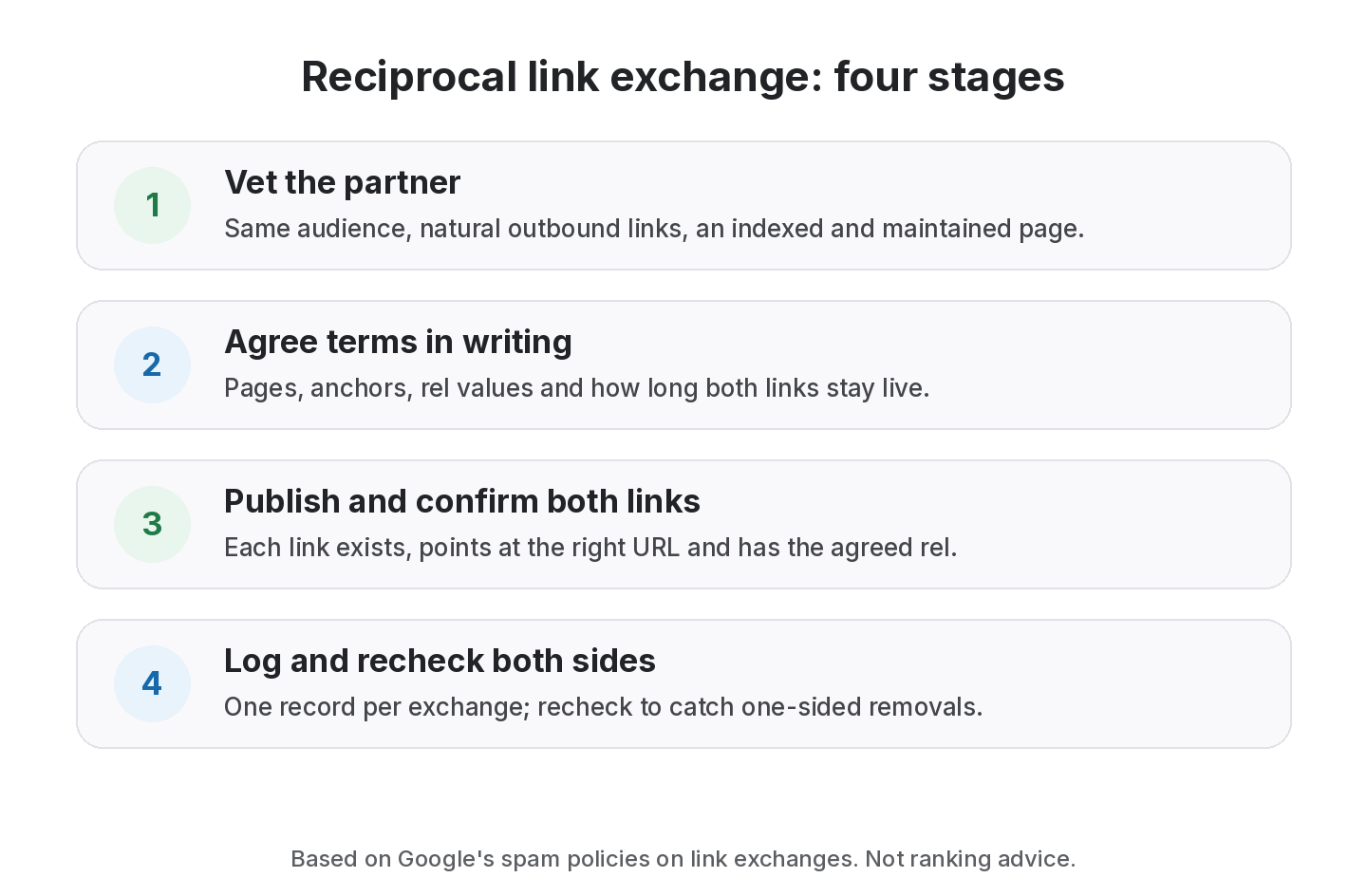
Key takeaways
- A reciprocal link exchange is a two-way deal: site A links to site B and site B links back.
- Google’s spam policies list “excessive link exchanges” as a link scheme, so scale and intent matter more than the format.
- The best test is relevance: would each link exist if nothing came back?
- Agree pages, anchors, rel values and duration in writing before either link goes live.
- Record both sides of every exchange and recheck them, because one-sided removals are common.
A reciprocal link exchange is an agreement between two sites to link to each other: you add a link to a partner’s page, and the partner adds a link back to yours. It is the oldest and most common form of link swap. Between two genuinely related sites, with links that help readers, it is a normal part of the web. Done in bulk, or only to move rankings, it falls under what Google calls link spam. This guide covers how reciprocal exchanges work, where the line sits, how to vet partners, and how to keep both sides of every deal on record.
Reciprocal link exchange at a glance
| Question | Short answer |
|---|---|
| What is it? | Two sites agree to link to each other |
| Is it allowed? | Occasional, relevant exchanges are normal; “excessive link exchanges” are a link scheme under Google’s spam policies |
| Who benefits most? | Partners with the same audience: suppliers, integrations, local businesses, co-authors |
| Biggest risk | Swapping at volume with unrelated sites |
| Most common practical problem | One side removes or changes its link and nobody notices |
A reciprocal link exchange works best between a few real partners who share readers, but falls short as a volume link building tactic.
What is a reciprocal link exchange?
In a reciprocal link exchange, both links point directly at each other. Site A links to a page on site B, and site B links to a page on site A. People also call it a link swap, a two-way link exchange or reciprocal linking.
Reciprocal links appear naturally all the time. A software company and its integration partner list each other. Two local businesses that refer customers to each other mention one another. A researcher and a journalist cite each other’s work. None of these needed an “exchange” conversation, yet each produced two links pointing at each other.
The SEO version is different only in intent: the two sides agree to the links mainly because each wants a backlink. That intent is what Google’s policy cares about.
Reciprocal vs three-way exchanges
A reciprocal exchange is the direct, two-site version. A three-way or ABC exchange spreads the deal across three sites so the links don’t point at each other. The three-way format is harder to track and doesn’t change how the policy applies. We compare the two in our three-way link exchange guide.
What Google says about reciprocal links
Google’s spam policies include, in the link spam section, “excessive link exchanges (‘Link to me and I’ll link to you’) or partner pages exclusively for the sake of cross-linking.” Two words do most of the work there: excessive and exclusively.
That means a reciprocal link isn’t a problem in itself. What raises risk is:
- swapping with many sites at once, mainly for the backlink;
- partner or “resources” pages that exist only to hold exchanged links;
- swaps with sites that have nothing to do with your topic;
- the same exact-match anchor text across many exchanges.
Google doesn’t publish a threshold, and nobody outside Google knows one. The safest reading is the people-first one in Google’s helpful content guidance: add a link when it helps the reader on that page.
Keep both sides of every swap on record
Log what you gave and what you got in one row, then check both links. Free for up to 20 links.
How to vet a reciprocal link partner
Most bad exchanges could have been avoided with ten minutes of checking. Look at these before you agree anything.
Relevance and audience
Read a few of the partner’s recent articles. Do they write for the same people you do? Would your readers find their page useful? If you would hesitate to link to them without a link back, that is your answer.
Outbound link behaviour
Open several of their posts and look at the outbound links. Natural sites link out sparingly and to a mix of sources. Sites that swap at volume tend to have many outbound links to unrelated businesses, often with exact-match anchors. That pattern is worth avoiding.
Page quality
The page that would link to you should be indexed, maintained and genuinely about the topic. A brand-new page created only to host your link adds risk and little value.
Who you are dealing with
Make sure the person offering the swap actually controls the site. Brokers sometimes offer placements on sites they don’t run, which makes later changes hard to resolve.
How to set up a reciprocal link exchange step by step
- Agree the pages. Name the exact page on each site where the link will go, and the exact page each link points to.
- Agree the anchors. Use natural, descriptive anchors. Avoid repeating the same keyword-rich anchor across exchanges.
- Agree the rel values. Decide whether each link is a normal link or nofollow. If either side was paid in any way, Google asks for rel=”sponsored”. Our nofollow vs dofollow guide explains the options.
- Agree the duration. Write down how long both links should stay live, and what happens if one is removed.
- Publish and confirm both links. Check that each link exists, points at the right URL and carries the agreed attribute.
- Record the deal in one place. One row or record per exchange, with both sides side by side.
- Recheck on a schedule. One-sided removals are the most common way exchanges go wrong.
Worked example: a fair two-way exchange
Imagine a project management blog and a time-tracking app that serve the same freelance audience. The app has a guide to “billing clients by the hour”; the blog has a guide to “estimating freelance projects”. Each guide genuinely benefits from linking to the other.
They agree:
- the blog links to the billing guide from its estimating article, with the anchor “billing clients by the hour”;
- the app links to the estimating guide from its billing article, with the anchor “how to estimate a project”;
- both links are normal links, with no payment involved;
- both stay live for at least 12 months.
The blog logs one record with both legs: its outgoing link, the incoming link, both pages, anchors, rel values and the agreed date. Four months later a recheck shows the incoming link has gone, because the app rewrote its billing guide. Because the record exists, the blog can email the app with the exact page, date and agreed terms, and the link is restored the same week.
Common reciprocal link exchange mistakes
- Saying yes to every offer. Inbox offers are rarely the partners you would choose.
- Exchanging between unrelated niches. A casino site and a parenting blog helps neither audience.
- Building a “partners” page full of swaps. Google names this directly.
- Recording only your side. If you only log the link you received, you can’t show what you gave when a partner removes theirs.
- No end date. Open-ended deals make it unclear whether a removal broke the agreement.
- Assuming the link stays a normal link. Partners sometimes add nofollow later. Check the attribute, not just the link.
What to record for every reciprocal exchange
A record turns a handshake into something you can check. For each exchange, note:
- partner name, contact and the site they control;
- your page that links out, and the partner page it links to;
- the partner page that links to you, and your target page;
- both anchors and both agreed rel values;
- agreed start date and minimum duration;
- current status of each leg: Active, Pending, Lost or Broken;
- the date each leg was last checked.
With both legs side by side, you can see instantly when an exchange has become one-sided, and you have the details ready for a polite follow-up.
How to choose whether to exchange at all
Ask these questions before every reciprocal link exchange:
- Would you link anyway? If not, don’t swap.
- Is the partner in your topic and market? Same audience, same language.
- How many exchanges have you done this quarter? If swaps are most of your new links, slow down.
- Is the anchor natural? Descriptive and varied, not the same commercial phrase.
- Can you record and recheck it? If you can’t keep track of it, don’t agree it.
- Is there a better way to earn the link? A useful guide or tool often earns the same link without a swap.
From the SEOENV team
We keep the outgoing and incoming link of every exchange in the same record. When a partner removes their side, the record shows exactly what was agreed, which keeps the follow-up short and friendly.
How SEOENV helps with reciprocal exchanges
SEOENV’s Master Link Exchange module records both sides of a two-way swap in one place: what you gave, what you got, the pages, anchors and agreed type. Each link also appears in the Link Tracker with a status (Active, Pending, Lost or Broken) and a type (Dofollow, Nofollow or Unknown). Partner contacts and deal history live in Partners.
Link exchanges are included on every plan. The Free plan covers 20 links, 5 partners and manual checks with Check all. Starter ($29 a month) adds automatic daily checks. You can read more on the link exchange tracker page or compare plans on the pricing page.
SEOENV is a record-keeping tool. It doesn’t find partners or arrange exchanges for you.
Sources
- Google Search Central: Spam policies for Google web search, link spam
- Google Search Central: Qualify your outbound links to Google
- Google Search Central: Creating helpful, reliable, people-first content
How we wrote this guide
This guide is written by the SEOENV team from how link builders actually record exchanges, paid placements and guest posts. SEOENV makes a backlink manager, so we say where a spreadsheet or another tool is enough. We do not quote statistics we cannot source.
Frequently asked questions
Related reading
Keep every link you build on record
Log exchanges, ABC swaps, paid links and guest posts in one place. The Free plan covers every link type for up to 20 links.


[…] tempting to ask for the keyword every time. For exchanges, agree natural anchors in writing; our reciprocal link exchange guide covers what to agree. For guest posts, let the anchor fit the sentence and the host’s […]
[…] In a two-way swap, you usually link from the site receiving the partner’s link, so the inventory mostly helps you check relevance and usage. See our reciprocal link exchange guide. […]
[…] Two-way reciprocal exchange: simpler and more transparent. If the partnership is genuine, the directness isn’t a problem. See our reciprocal link exchange guide. […]
[…] posting process →Reciprocal link exchange guide →Guest post management […]