Anchor Text Ratio: How to Keep a Natural Anchor Mix
Published on October 14, 2026 | 6 Min Read
Key takeaways
- Anchor text ratio is the share of each anchor type (branded, URL, generic, partial match, exact match) across links to a page or site.
- There is no official “correct” ratio; Google doesn’t publish one, and fixed percentages online are opinions.
- Natural profiles are usually led by branded and URL anchors, with exact-match commercial anchors a small minority.
- Anchors you control (exchanges, guest posts, paid links) are where over-optimisation happens.
- Review the mix per target page, not only across the whole site.
Anchor text ratio is the proportion of different anchor text types in the links pointing to a page or site: how many links use your brand name, how many use a bare URL, how many use generic words like “this guide”, and how many use the exact keyword you want to rank for. People watch it because a profile dominated by exact-match commercial anchors looks engineered rather than earned. There is no official target ratio; Google doesn’t publish one. What you can do is understand what a natural mix looks like, measure yours and stop over-optimised patterns where you control the anchors.
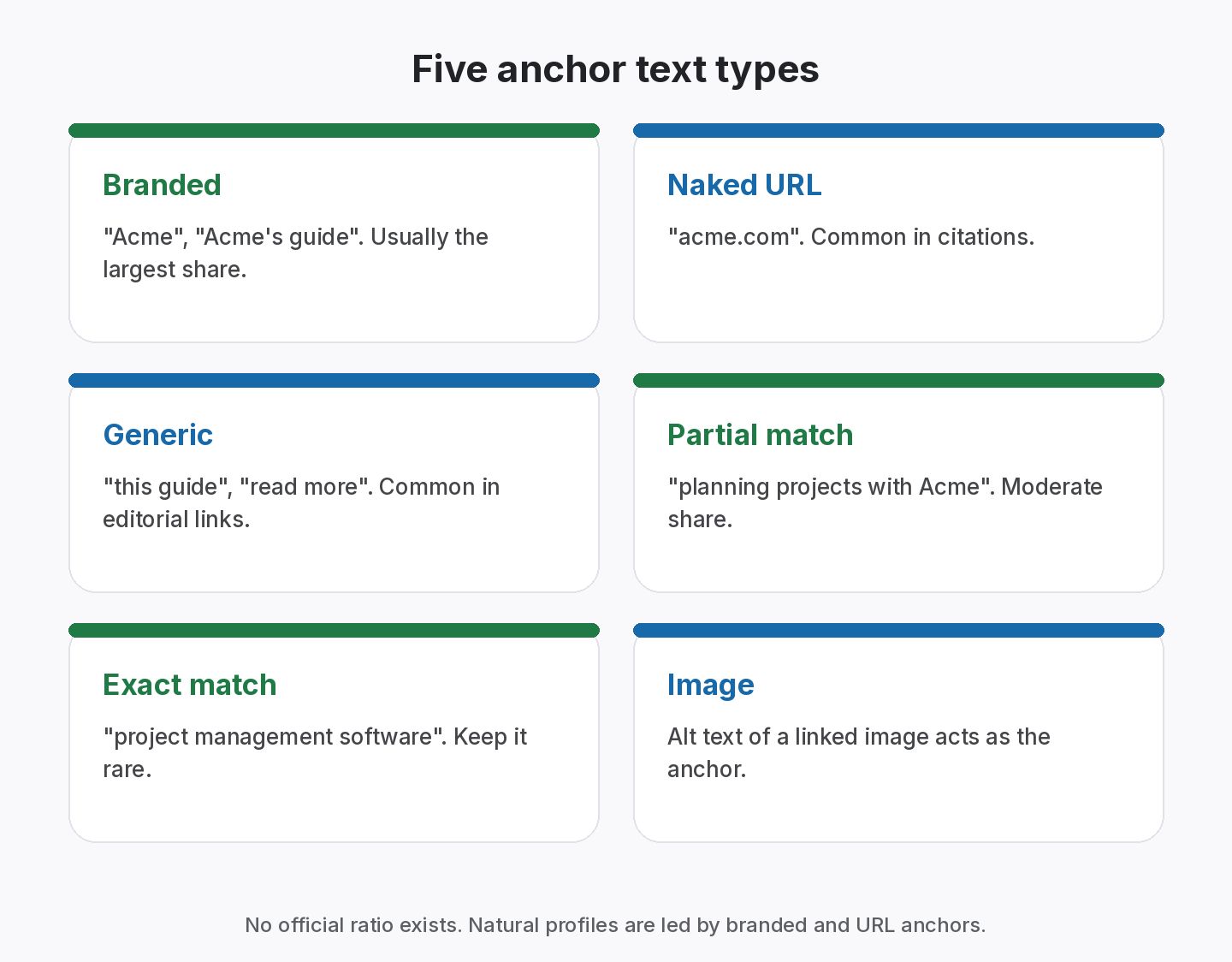
Anchor text types at a glance
| Anchor type | Example (for a project tool) | Typical role in a natural profile |
|---|---|---|
| Branded | “Acme”, “Acme’s guide” | Usually the largest share |
| Naked URL | “acme.com”, “https://acme.com/guide” | Common, especially in citations |
| Generic | “this guide”, “click here”, “read more” | Common in editorial links |
| Partial match | “planning projects with Acme”, “project planning tips” | Moderate |
| Exact match | “project management software” | Small share; the one to watch |
| Image / empty | Alt text of a linked image | Varies |
A branded-led anchor mix works best for staying natural, but falls short if you then use exact-match anchors on every link you build yourself.
What is anchor text?
Anchor text is the clickable text of a link. In the HTML `project planning guide`, the anchor text is “project planning guide”. For linked images, the image’s alt text plays a similar role.
Google’s link best practices describe good anchor text as descriptive, reasonably concise and relevant to the page it links to. Anchors help readers and search engines understand what the target page is about.
What is an anchor text ratio?
An anchor text ratio expresses how your links divide between anchor types. You might find, for example, that most links to your homepage use your brand name, while links to a feature page use a mix of partial-match and generic anchors.
Is there a correct anchor text ratio?
No official one. You’ll see percentages online, such as “keep exact match under a certain share”, but they come from individual studies of particular sites and niches, not from Google. Treat them as rough context, not targets. The more useful approach is to compare your profile with:
- what you would expect from links people gave freely;
- the pages that rank well in your own niche;
- your own past profile, to spot sudden shifts.
Why anchor text ratio matters
Exact-match anchors were once a strong ranking signal, which made them easy to abuse. Google’s later updates targeted manipulative link patterns, and its spam policies mention “keyword-rich anchor text links” in the context of large-scale guest posting and link schemes. A profile where many built links use the same commercial phrase is one of the clearest signs that links were arranged rather than earned.
Natural editorial links rarely look like that. People link using your brand, the article title, a URL or whatever phrase fits their sentence.
See the anchor mix for every link you build
Log anchors as you add links; the Anchor Text Heatmap with alerts comes with Growth.
How to measure your anchor text ratio
- Collect your links. Your own records for links you built, plus a crawler export for others.
- Group by target page. Ratios across a whole site hide problems on individual pages.
- Classify each anchor as branded, URL, generic, partial match, exact match or image.
- Count each type and calculate its share.
- Separate built from earned. Look at the links you arranged on their own; that’s where you have control.
- Compare over time. A sudden jump in exact-match anchors is worth investigating.
A quick classification guide
- If it contains your brand, it’s branded, even if it also contains a keyword.
- If it is the URL itself, with or without https, it’s a naked URL.
- If it would make sense for any page (“here”, “this article”), it’s generic.
- If it contains part of your target keyword or a close variant, it’s partial match.
- If it is your target keyword exactly, it’s exact match.
Signs of anchor over-optimisation
- many built links to one page using the same keyword;
- exact-match anchors appearing on unrelated sites;
- anchors that read awkwardly in the sentence around them;
- a sharp rise in commercial anchors after a link building push;
- exact-match anchors concentrated on money pages.
How to fix an over-optimised anchor mix
You can’t change links you don’t control, but you can change your own behaviour.
- Vary future anchors. Brief writers and partners with branded and descriptive options.
- Ask partners to adjust anchors on links you arranged, where they are happy to.
- Earn more natural links with content people cite in their own words.
- Point some links at supporting pages, not only the money page.
- Avoid “fixing” by disavowing good links just because of their anchors.
Anchor text in link exchanges and guest posts
Links you arrange are where anchor ratios go wrong, because it’s tempting to ask for the keyword every time. For exchanges, agree natural anchors in writing; our reciprocal link exchange guide covers what to agree. For guest posts, let the anchor fit the sentence and the host’s style.
Worked example: rebalancing one page’s anchors
Imagine a software company with a feature page that has picked up links from three sources over a year: editorial mentions, guest posts and a handful of exchanges. The numbers below are invented to illustrate the method.
| Source | Branded / URL | Generic | Partial match | Exact match |
|---|---|---|---|---|
| Editorial mentions | Most | Some | A few | Almost none |
| Guest posts (built) | A few | A few | Some | Most |
| Exchanges (built) | Some | A few | Some | Some |
The editorial links look natural. The built guest post links don’t: most use the exact phrase the page targets, because every writer worked from the same brief. The fix isn’t to disavow anything. The team rewrites the brief to offer branded and descriptive anchor options, asks two friendly hosts to vary existing anchors, and points future guest post links at a supporting guide instead of the feature page. Three months later, the built links look much more like the earned ones.
Anchor text and internal links
Anchor ratio advice is mostly about backlinks, but internal links matter too. On your own site, descriptive anchors that match the target page help readers and search engines, and there’s no reason to vary them artificially. Google’s link guidance asks for anchor text that makes sense out of context. Use your internal links to describe pages clearly, and save the caution about exact-match patterns for links you arrange on other sites.
How to choose anchors for new links
- Would the host write it this way? If not, rewrite it.
- Does it describe the target page? Descriptive beats keyword-stuffed.
- What does the page already have? If exact match is already common, use branded or generic.
- Is it a paid link? Then it should be sponsored, and anchor optimisation is beside the point.
- Can you track it? Record every anchor you agree so you can see the mix.
From the SEOENV team
When we review anchor mixes, we look at built links separately first. Earned links are usually fine; it’s the links we asked for where the same phrase creeps in, often because several writers used one brief.
How SEOENV helps with anchor text ratio
SEOENV records the anchor of every link you log, by client and project. On Growth ($149 a month), the Anchor Text Heatmap shows the mix per target and alerts you to over-optimisation. Read more on the anchor text analysis page, or see what’s in each plan on the pricing page.
SEOENV analyses anchors on the links you track. It doesn’t crawl the web for links you didn’t log.
Sources
- Google Search Central: Make your links crawlable (anchor text best practices)
- Google Search Central: Spam policies for Google web search, link spam
- Google Search Central: Creating helpful, reliable, people-first content
How we wrote this guide
This guide is written by the SEOENV team from how link builders actually record exchanges, paid placements and guest posts. SEOENV makes a backlink manager, so we say where a spreadsheet or another tool is enough. We do not quote statistics we cannot source.
Frequently asked questions
Related reading
Keep every link you build on record
Log exchanges, ABC swaps, paid links and guest posts in one place. The Free plan covers every link type for up to 20 links.


[…] Copy it exactly. Over time this column shows your anchor mix; see our anchor text ratio guide. […]
[…] partial and exact anchors on built links. A rising exact-match share is a warning sign; our anchor text ratio guide explains […]